A reverse osmosis system pushes water through a very fine membrane, holding back much of what's dissolved in it. The result is drinking and cooking water with far lower total dissolved solids. It's installed at one spot, usually under the kitchen sink, with its own faucet, rather than treating the whole house.
For homes on Rio Rancho city water
The city's groundwater is tested and reported every year, and its Consumer Confidence Report shows compliance with federal standards. So for most people on city service, RO is a preference rather than a necessity. They want ice cubes that aren't cloudy, coffee that tastes like coffee, and a way to stop hauling cases of bottled water home from the store on Southern Boulevard. Mineral-rich groundwater tends to carry a fair load of dissolved solids, and RO is the tool built to bring that down.
For private wells in Rio Rancho Estates and outlying lots
This is where RO earns its place. A private well isn't regulated like the city system, and the owner is the one responsible for knowing what's in it. Arsenic occurs naturally in groundwater in parts of the Middle Rio Grande region, and nitrate can show up in wells too. Reverse osmosis is the standard point-of-use approach for reducing arsenic, nitrate, fluoride and lead. How well it performs depends on the specific contaminant and the rest of your water chemistry, which is why we don't make promises before we see results.
Our order of operations on a well
First, the free on-site test for hardness, TDS, pH, chlorine, iron and manganese, and sulfur. Second, we help you arrange lab testing for bacteria, nitrate and arsenic. Third, we recommend equipment based on those results. If a lab finds bacteria, that calls for disinfection and isn't something RO is meant to solve; we'll point you in the right direction.
Installation in a typical Rio Rancho kitchen
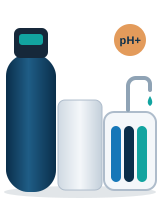
Our 600 GPD tankless unit is compact, so it usually fits under the sink alongside the disposal and the trash can. We drill one hole in the counter or sink deck for the dedicated faucet, connect to the cold line and the drain, and finish with an alkaline stage that adds back a little mineral for taste. If you already have a softener in the garage, the RO simply draws from the softened line. The whole visit is usually well under half a day.