
Whole-home filtration · Corrales
Filtering Corrales well water at the point it enters the house
Grit in the aerators, an earthy taste in the coffee, a whiff of something in the shower. On a private well these are yours to solve, and whole-home filtration is how most of them get solved.
Match the equipment to the problem
Corrales homeowners often ask us for "a filter" when they mean three different things. Here's what each technology actually reduces.
| Issue in the water | Softener | Catalytic carbon | RO at the sink |
|---|---|---|---|
| Hardness (scale) | ✔ | ✘ | Drinking water only |
| Sediment and grit | ✘ | ✔ | Drinking water only |
| Chlorine taste and odor | ✘ | ✔ | Drinking water only |
| Many VOCs | ✘ | ✔ | — |
| Nitrate | ✘ | ✘ | ✔ |
| Arsenic | ✘ | ✘ | ✔ |
| Bacteria | ✘ | ✘ | ✘ (needs disinfection) |
RO performance depends on the contaminant and your water, so we confirm it with testing. Iron, manganese and sulfur on a well can be handled with specialty media once a test shows they're present.
Why carbon earns its place on a valley well
Every home in Corrales runs on a private well, and well water arrives unfinished. There's no treatment plant ahead of you settling out sediment or polishing the taste. Some homeowners chlorinate their own well after a repair or a bacteria result, and then they're living with the chlorine smell that follows. Catalytic carbon reduces chlorine taste and odor, sediment and many volatile organic compounds, which covers a lot of the day-to-day complaints we hear in the village.
Be clear about the limits, though. Carbon doesn't remove hardness, nitrate or arsenic. With septic systems sharing so many Corrales lots with wells, nitrate is worth a lab test, and if it needs reducing, that's a job for reverse osmosis rather than a whole-home filter.
What the free test checks first
At your sink we measure hardness, total dissolved solids, pH, chlorine, iron and manganese, and sulfur. Those numbers tell us whether plain catalytic carbon will do or whether your well needs specialty media for iron, manganese or a rotten-egg sulfur smell. For bacteria, nitrate and arsenic we help you set up lab testing, because those can't be judged on the spot.
How the water flows after we install
- 1
Well and pressure tank
Water comes up from your well and fills the pressure tank. We tie in after the tank, never before it.
- 2
Soft + filtered tank
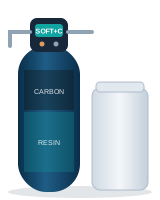
In our Soft + Filtered Home package, softening resin and catalytic carbon share one tank, usually in the garage or utility room.
- 3
Into the house
Treated water feeds the house. Pasture and garden spigots can stay on raw well water if you prefer.
Soft + Filtered Home is $3,450 installed, with free installation by our own crew in about half a day and a lifetime warranty. Financing starts at $59/mo. Compare it with the other options on our packages page, read the general whole-home filtration overview, or head back to water treatment in Corrales.
Filtration questions from Corrales
I shock-chlorinate my well sometimes. Will carbon take care of the smell?
Catalytic carbon reduces chlorine taste and odor, so it helps with the lingering smell after routine use. Right after a heavy shock treatment, follow the flushing instructions you were given before relying on the filter.
Does a whole-home filter remove nitrate from septic systems nearby?
No. Carbon doesn't remove nitrate. Get a lab test first, and if nitrate needs reducing in your drinking water, a reverse osmosis system at the kitchen sink is the standard approach.
My well water smells like rotten eggs. Is that something you filter?
That smell often points to sulfur. Our on-site test checks for it, and if it's present, specialty media can be added to address it. We only recommend it once the test confirms it.
Find out exactly what's in your water — free.
A 15-minute on-site test with results in real time, a plain-English report, and an honest recommendation. No pressure, no obligation.