
Whole-home filtration · East Mountains
Cleaner-tasting water for every tap in your mountain home
Whether your water arrives from a community system or comes up from your own well, filtration starts with figuring out what's actually bothering you: a chlorine taste, grit in the aerators, or a smell from the shower.
Common complaints
What filtration can help with east of the Sandias
These are the issues that tend to bring Tijeras and Cedar Crest homeowners to us. We confirm each one with a test before recommending anything.
Chlorine taste or smell
Community systems that disinfect can leave a residual you notice in a glass or the shower. Catalytic carbon reduces that taste and odor throughout the house.
Sediment and grit
Some wells push fine particles into the plumbing, clogging aerators and wearing on valves. Filtration catches sediment before it travels.
A rotten-egg odor
Some mountain wells carry a sulfur smell. If the on-site test confirms sulfur, specialty media can be added to address it.
Carbon filtration also reduces many VOCs. It does not remove hardness, arsenic or nitrate.
Well or community system: how the plan changes
Bernalillo County reports that the East Mountains split roughly evenly between homes on wells and homes on community water. And because the limestone aquifer here is fractured, quality shifts from one well to the next. Your filtration plan depends on which side of that split you're on.
| Community system | Private or shared well | |
|---|---|---|
| Most likely reason to filter | Disinfectant taste and odor | Sediment, odor or iron, depending on the test |
| Where official numbers come from | Your provider's annual water quality report | Testing you arrange as the owner |
| Media we'd start with | Catalytic carbon | Catalytic carbon, plus specialty media if testing shows iron, manganese or sulfur |
| Lab testing help | Usually not needed | Yes, for bacteria, nitrate, arsenic and more |
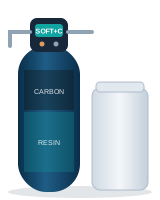
Because East Mountain groundwater from limestone often tests hard as well, many homeowners pair filtration with softening. Our Soft + Filtered Home package puts the softener and the catalytic carbon in a single tank for $3,450, installed. If hardness is the main problem, see our East Mountains softener page instead.
From test to installed, usually in one half-day visit
- 1
Test at your tap
About 15 minutes for hardness, TDS, pH, chlorine, iron, manganese and sulfur, with a printed plain-English report. Well owners can add lab testing.
- 2
Pick the media
Carbon for taste and odor, or specialty media if the readings call for it. We explain why for each choice.
- 3
Install after the pressure tank
On wells the tank follows the pressure tank, in a heated garage, utility room or basement. On community water, it goes near the main line.
Filtration questions from the East Mountains
Will a whole-home filter make my well water safe to drink?
Not by itself. Carbon filtration improves taste, odor and sediment, but it doesn't remove arsenic or nitrate, and it doesn't treat bacteria. Lab testing tells you whether you need reverse osmosis or disinfection too.
I'm on a community system in Sandia Park. Do I need this?
Only if the taste or smell bothers you, or the test turns up something worth addressing. Check your system's annual water quality report and we'll go over it with you.
Does a filter use much extra water?
Filter media is periodically rinsed clean, which does use some water. With groundwater levels down in parts of the mountains, we set that up around your household's actual use and explain it before you decide.
More on the technology lives on our main whole-home filtration page, and local water background is on the East Mountains page.
Find out exactly what's in your water — free.
A 15-minute on-site test with results in real time, a plain-English report, and an honest recommendation. No pressure, no obligation.