Why hardness follows the limestone
Much of the groundwater east of the Sandias moves through fractured and solution-channeled limestone. As it does, it dissolves calcium and magnesium from the rock. Those two minerals are what "hard water" means, and limestone groundwater commonly tests hard as a result.
What makes the mountains tricky is the word "fractured." Water doesn't sit in one even layer; it follows cracks and channels. A home in Cedar Crest and another a short walk away can draw from different fractures and get different water. We've learned not to guess. Your test results will show where your water lands, and we size the softener from that number, not from a neighbor's.
About half of East Mountain households are on private or shared wells and about half on community water systems. Either way, if the source is limestone groundwater, scale is likely part of the story. If you're on a community system, its annual water quality report gives you the official picture; we add a reading taken at your own tap.
What a softener does, and what it doesn't
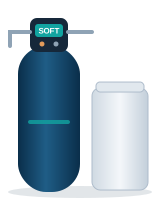
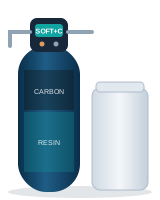
A softener uses ion exchange: resin beads trade away the calcium and magnesium as water flows through. That protects water heaters, tankless units, dishwashers and fixtures, and it makes a real difference to dry skin in mountain air. It can also handle a small amount of iron.
It will not remove arsenic, nitrate, chlorine or bacteria. If a lab test on your well flags any of those, a softener isn't the fix, and we'll say so. That's where reverse osmosis at the kitchen sink or a referral for disinfection comes in.
Built for a place where water is precious
With mountain groundwater levels falling in places, water spent on regeneration matters. Our digital metered valve regenerates based on the water you actually use, not on a calendar, so the softener isn't rinsing on days it doesn't need to.